India
8,000 BCE to 600 CE
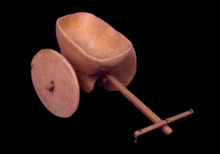
Wheel Cart

Edicts of Ashoka
Technology
The Edicts of Ashoka are a collection of inscriptions on the Pillars of Ashoka, also on boulders and cave walls. The edicts describe the first wide expansion of Buddhism. These inscriptions show Ashoka's beliefs in the Buddhist concept of dhamma and his efforts to develop the dharma throughout his kingdom. Though Buddhism and the Buddha are mentioned, the edicts focus more on social and moral precepts, instead of the religion point of view.
Hand-propelled wheel cart, Indus Valley Civilization. Around 3000 BCE-1500 BCE.
During the Gupta period mathematics was developedin a more advanced way than any other nation of antiquity. India came up with a basic algebra, but led to more calculations than were possible for the Greeks and led to the study of numbers. The earliest inscription of the data by a system of nine digits and a zero is dated around 595 A.D.
This is the Great Stupa at Sanchi, India, established by Ashoka the great. A stupa is a structure containing Buddhist relics used by Buddhists as a place of worship.

Mathematics

Stupa